Blackberries are not uncommon in the Siberian region. But what type and variety of this berry is suitable for cultivation in a harsh climate? I share my experience of successfully growing Thornfree blackberries – a unique American variety. The main thing is to take care of covering the berry bushes for the winter, in early spring and in August. This way, the blackberries will not freeze and will gain the sum of positive active temperatures for the full ripening of the crop and shoots.
Differences between blackberries and raspberries
Blackberry is a “sister” of raspberry, and it lives next to grapes. Blackberry is morphologically very similar to raspberry – the same perennial roots, the same 2-year-old above-ground shoots that grow in the first year, and in the second year they bear fruit and die.
- Blackberries are not a very winter-hardy crop, and in Siberia and central Russia they need to be preserved in winter. Therefore, we bend the annual shoots and cover them with snow.
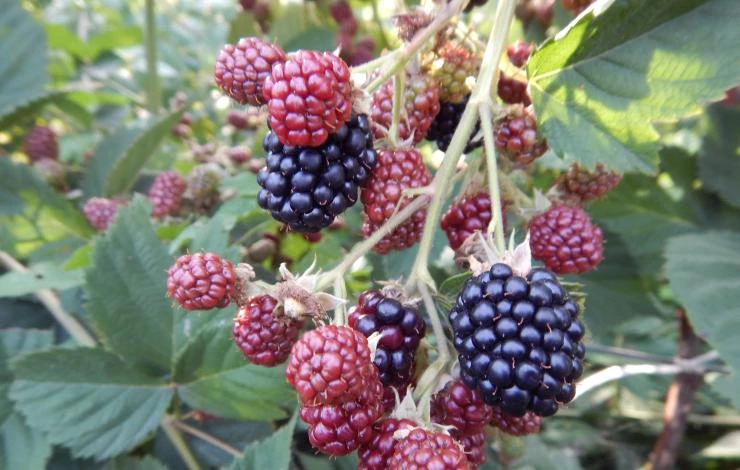
- Blackberries differ from raspberries in that they have a more powerful bush, black berries, a non-separating receptacle, and productivity that is 3-4 times higher than that of their relatives.
- Blackberries are rich in beneficial and medicinal properties.
And although it is still far from being as popular as raspberries, this amazing black berry is gradually and successfully moving north, conquering ever larger areas in amateur gardens.

When and how to plant a seedling and care for a berry bush?

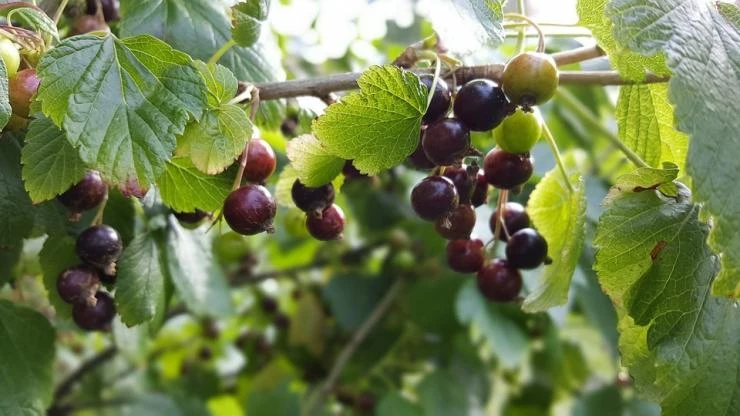
Photo: Blackberries are distinguished by their generous fruiting, but are inferior to raspberries in popularity and winter hardiness
Blackberry varieties for Siberia
Thickets wild, real blackberries can be found in the south of Novosibirsk Oblast in the Suzunsky District. This is a real “devil”! It is sometimes difficult to escape from its prickly paws – it is simply dangerous.
Grows well in Siberia Blackberry creeping glaucous (creeping). It is very winter-hardy, as it is always covered with snow. This variety grows quickly. We could not breed this prickly “impudent” for a long time, because its roots are deep, and it is very difficult to destroy them.
Cultivated blackberries are mainly “American”. They are partly bred in Poland and Ukraine. In the USA, blackberries are grown on an industrial scale. There are many varieties with thorns, but they are difficult to work with because of their strong thorniness.
- Breeders have developed a number of thornless varieties with smooth shootswhich we, gardeners, have come to love.
- There are varieties of blackberries that produce berries the size of a chicken egg (Kiova). But at the moment, for Siberian conditions, this is only a prospect.

Photo: American thornless blackberry varieties are suitable for Siberia
We tested several varieties of blackberries from gardener Yakimov V.V. Here are some observations.
Boysenberry
- This is a raspberry-blackberry hybrid with very flexible, thin shoots.
- Must be grown on a trellis.
- Not winter-hardy, many shoots grew, but there was no harvest.
Removed from testing.
______________________________________________
BOYNESBERRY BLACKBERRY: GROWING EXPERIENCE
______________________________________________
| Bristol |
- Raspberry-blackberry hybrid.
- Powerful, bends poorly.
Further testing is required.
| Black Satin |
- A powerful bush, difficult to bend.
- The harvest was low, the berries ripened late.
Removed from testing.
| Agavam |
- A very thorny variety is called “devil”.
- I uprooted this Samara gift 3 years ago, but I still can’t get rid of the thorny growth.
Thornless Evergreen
A variety with creeping herbaceous shoots with evergreen leaves. Grows to a length of about 7 m.
- The brushes contain numerous berries (up to 70 pieces) weighing 3–3.5 g.
- The berry is very tasty, but is inferior to Thornfree in size.
- Ripens well, a week earlier than Thornfree.
- When the roots are damaged, shoots appear with thorns.
When growing, a trellis is a must. It is necessary to cover it well (for example, in the snowless November of 2015, the stems froze). It grows on our plot

Photo: Thornless Evergreen variety
Thornfree
Of the six varieties studied, one stood out – a unique American variety. Thornfree. This variety is most common in Siberia. Very productive, with fairly large, big berries.
- The shoots need to be grown on a trellis. Its shoots are thornless, vigorous, thick, and reach 5–6 m in length. The ends of shoots up to 2 m long usually do not ripen and dry up by spring.
- This variety has very difficult to bend replacement shoots. They break off at the base. Therefore, when they reach 15-20 cm, they must be carefully bent horizontally and pinned. Having taken this shape, they grow in this position.
- The variety is late, so it is necessary to increase the sum of active temperatures.
This variety has no drawbacks, and its main advantage is its colossal yield. In 2015, we collected 12 buckets of blackberries (about 85 kg) from four fruiting bushes and one young one – that is, we got 16-18 kg of berries from a bush. And that says it all!

Photo: Thornfree Berries
Thornfree Blackberry in Siberia
Thornfree is a variety with many advantages:
- high-yielding (up to 20 kg of blackberries per bush),
- large-fruited (berry weight, on average, 5–8 g),
- delicious,
- easy to carry and transport,
- very disease resistant,
- quite winter-hardy.
Thornfree’s advantage is
- absence of thorns,
- relatively uniform ripening of berries,
- absence of offspring
There is only one but – this late ripening variety. Andrianova O.P. from Saratov agrees with our observations. Growing technologies differ in different regions. For example, in Saratov spring begins 1–1.5 months earlier, and winter – a month later than in Siberia, and there blackberries are put on the trellis as early as possible.
We grow berries in a slightly different way.

Photo: Thornfree blackberries need proper agricultural technology to increase yields in Siberia
How We Grow Thornfree Blackberries in Siberia
We have been growing blackberries for a long time. We purchased a large bush of the variety Thornfree I divided it into 5 parts and planted it in a 2.5 x 1.5 m square. At first it was like a “stepdaughter” – it grew and grew. I paid all my attention to the raspberries, and then to the grapes.
But blackberries are a very tenacious, hardy and grateful crop. Although we were satisfied with their yield, the berries did not ripen well and did not accumulate enough sugar. And how could they be accumulated practically in the fall – there was little warmth and sun! We had to look for this missing warmth. And a solution was found.
If you dream of achieving high results, put in adequate efforts!
In our case, we improved agricultural technology:
- began to prune the bushes correctly, leaving the optimal number of annual shoots;
- began to cover annual shoots well, protecting the bushes from winter frosts;
- They began to water the plants more intensively.
But the most important thing is that we get an additional amount of active temperatures at the start, in early spring, and at the end of summer – in autumn.
I consider this to be the main technique for growing blackberries in central Russia and Siberia.

Photo: The key to successful blackberry growing in Siberia is to get the sum of active temperatures
Planting blackberries in Siberia
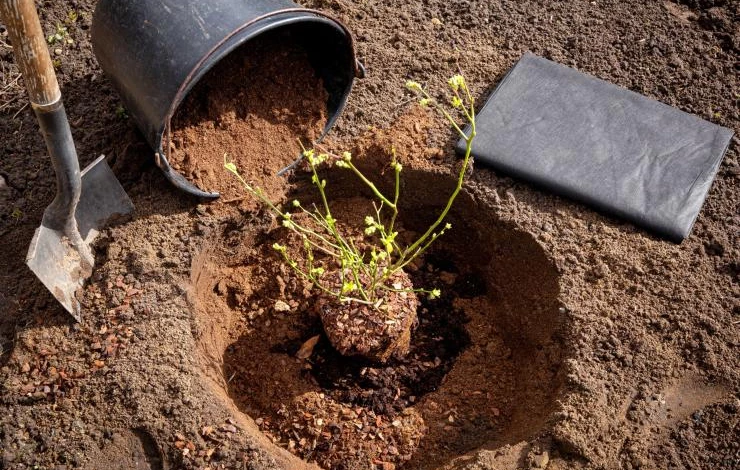
- I dig a planting hole (50x50x50 cm). I fill it with a substrate of soil, sand and humus (3:1:1). I season it with complex fertilizer (for example, Fertika).
- I plant the plant at the level of the root collar and water it (at least 1 bucket per 1 plant).
- If several plants are planted, the distance between them should be at least 2.5 m.
- When planting blackberries, the main thing is not to dry out the root system.
Planting can be done both in autumn and spring.
I grow my planting material through the tops of the shoots and with the help of green cuttings.
- During the growth period, I bend them to the ground, make a depression and fill in the top.
- It is advisable to continue growing rooted cuttings for another year.
______________________________________________
GREEN CUTTINGS IN SUMMER: HOW TO PROPERLY PREPARE PLANTING MATERIAL

Caring for Blackberries in Siberia
Plant care is normal.
- For the winter, blackberries need to be covered with agrotex or other covering material, and then with film on top.
- Blackberries love moisture, so they need to be watered regularly (preferably using a drip method).
- Like other crops, the plant needs to be periodically fed with complex fertilizers and humus.
- To maintain and strengthen immunity, I spray it with Novosil.
_____________________________________________
BLACKBERRY IN SIBERIA: PLANTING AND CARE
_____________________________________________
Shelter for the winter
In the first years, we simply bent the bushes, threw boards and tops on top. As it turned out, this was not enough – in a winter with little snow, the blackberries froze.
- So now in the fall we lay the shoots as close to the ground as possible, with spacers made from old wooden boxes below and above the shoots.
- Cover the top with agrotex and film.
- Reliable wintering will be ensured by growing blackberries in boxes or in semi-buried trenches – like grapes. From this year we are switching to this type of crop cultivation.
In warm regions, these concerns disappear, and Thornfree rewards gardeners with a wonderful harvest – just form it correctly and water it.
____________________________________________
STORAGE OF BLACKBERRY FOR THE WINTER: MATERIALS AND TECHNIQUES

Photo: Shelter for the winter
Shelter in spring
Most varieties of blackberries are late ripening. Therefore, it is necessary to gain additional SAT (sum of active temperatures). This can be done in the spring, without removing the shelter, for a month, by substituting arches.
- In the spring, we remove the cover as early as possible,
- we remove fallen green leaves and remains,
- drying,
- put long
- and again we cover it with agrotex and film.
Vegetation starts 15-25 days earlier, and if by May 20-25 plants without shelter only begin to vegetate, then here shoots already grow by 25 cm! Blackberries begin to bloom almost a month earlier than usual! With this technique we gain SAT over 300°C.
Shelter in August
It is advisable to provide additional cover in August. This will create additional warmth, and the berries will ripen well.
- In warm August, the berries already begin to ripen. But due to the long fruiting period, part of the harvest still goes to September.
- Therefore, we throw a film over the trellises, thereby creating a greenhouse effect; the berries begin to ripen faster.

Photo: Covering blackberries in August for ripening
Pruning blackberries in Siberia
Pruning to increase fruit-bearing shoots (primary pinching at a height of 1.5 m, and then on the lateral branches) is justified only in warm regions. In Siberia, such pruning will have a negative effect – the shoots will not ripen. Therefore, there is no need to rush.
- In the fall, we cut out the 2-year-old, broken, excess, thin stems that have borne fruit.
- In spring, we leave 4-5 shoots in the bush and shorten them to 2-2.5 m. Usually, shoots longer than 3 m do not mature and do not survive the winter, but from the base to 1-1.2 m they branch out without additional pinching.
- We tie the shoots to the trellis. This is the main provision in problematic regions.

Photo: Blackberry Bouquets
Harvesting blackberries in Siberia
Blackberries have the highest potential.
- The berries of the blackberry are dry, together with the receptacle.
- Blackberries are very well stored, partially ripen, and can be transported over long distances.
- One of the inconveniences is the extended ripening of the berries. They need to be picked frequently.
Positive features of Thornfree blackberry:
- Unripe Thornfree berries ripen well and are stored in the refrigerator.
- That’s why sometimes we pick unripe berries along with ripe blackberries and put them in the refrigerator (up to 5-6 days).
- Blackberries ripen and have virtually no time to spoil.
Up to 70 blackberries are formed on one lateral (fruit branch).
- During autumn pruning, there are still some shoots with unripe berries left, which I cut off together with the laterals and put in buckets of water in a warm room.
- Almost all berries ripen within 5–7 days.
This is waste-free production.