Every owner of a plot of land, whether it is a summer cottage of 6 acres or the territory around a private home, tries to improve it as best as possible. Summer is the time of a riot of colors behind the summer cottage fence: you can admire the beauty of a carefully thought-out landscape, arranged by the owner of the territory with great love and knowledge of the matter, for hours. Such a brightly flowering, eye-pleasing plant as hydrangea will serve as a decoration of any plot. Let’s talk about growing it in the garden and tell you in detail about what kind of fertilizers hydrangea requires large-leaved at different stages of development.
Table of contents
1. Description of the plant 1.1. Comfortable conditions for hydrangea 1.2. Planting and growing 2. How to feed large-leaved hydrangea 2.1. After landing 2.2. In the spring 2.3. During budding 2.4. Before flowering and in autumn 2.5. In case of micronutrient deficiency
Description of large-leaved hydrangea
Hydrangea macrophylla is a gorgeous ornamental shrub that can become the highlight of your garden. With its long and lush flowering, it not only evokes admiring and often envious glances from others, but also attracts insects.
This perennial plant has East Asian roots in its origin. Its homeland is considered to be China and Japan. Among the scientific community, it is called macrophylla or garden hydrangea. Among other types of culture, it is the most capricious, although not very difficult to grow.
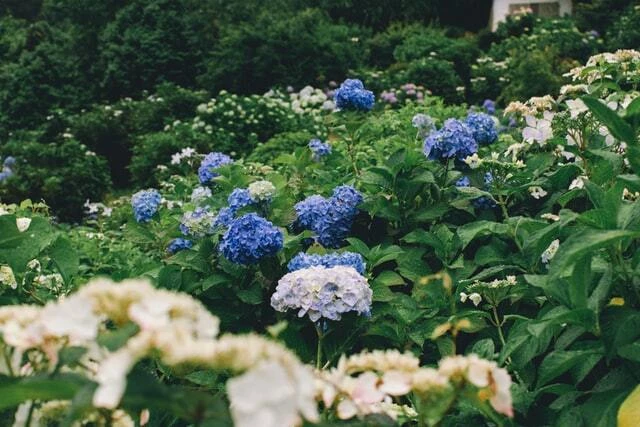
The garden beauty is a bush with a height of 40 cm. Often it reaches a height of 1-1.5 meters. The branches of the plant are equipped with large leaves (which is easy to guess from its name) and the same large inflorescences. The decorative bush blooms almost the entire season: from July to September (often including October).
By the way
Some summer residents leave the inflorescences even for the winter period. Although the former beauty is no longer observed, the graceful branches that have shed their leaves continue to decorate the plot.
Some summer residents may say that large-leaved hydrangea does not bloom in their gardens. It should be noted that inflorescences in most representatives of the culture begin to form only in the second year of life. However, there is also a remontant variety of the bush, which can bloom abundantly already in the first year.

Large-leaved hydrangea does not have any special requirements for soil composition, but still prefers acidic soil. The color of the inflorescences may depend on its properties (mainly acidity). Gardeners often use this property to give the bushes an unusual color.
To change the color of flowers, summer residents use various methods:
- bury rusty metal parts or nails under the bushes;
- watered with water containing plant dyes dissolved in it;
- add copper sulfate.
Unfortunately, the shrub is quite thermophilic, and therefore is highly susceptible to negative temperatures during the long winter period.
Interesting
In our country, winter-hardy species of large-leaved hydrangea are mostly widespread. This explains its wide area of cultivation in the vast territory of Russia.
In regions with long, low-snow winters, it is recommended to cover the garden plant for safety.

In summer, hydrangea is propagated by cuttings in June–July. The main thing for successful rooting is moderate watering and shading when kept outdoors.
Conditions for growing ornamental shrubs
As mentioned above, the bush prefers “sourness”. Therefore, for its planting, it is worth preparing acidic soil with the addition of peat or coniferous litter. In this case, there is no need to carry out any measures to deoxidize the soil, including the use of wood ash.
The bush loves moisture, preferably also with a sour taste.
Important
Hydrangea will appreciate water with citric acid dissolved in it. However, stagnation of water should not be allowed. It is advisable to create good drainage for it.

Features of planting shrubs
Garden hydrangea is planted in early spring in holes measuring 30 cm (width and depth). The distance between individual specimens should be at least a meter, so that the crop can grow freely in the future. When planting, a special complex fertilizer containing nitrogen and a set of microelements should be added, the composition of which determines the various shades of inflorescences, and abundant watering should be carried out in the planting holes.
For example, you can mix a glass of superphosphate with the addition of potassium sulfate and ammonium sulfate (20 g each) in the planting hole. You can also use bone meal instead of phosphorus fertilizer.
note
When planting a seedling, do not bury its root collar. It should be at the level of the surface of the area.
If you have a specimen with a rich root system and long branches, they can be shortened slightly, leaving at least 3 buds on the young branches of the first year. Let me remind you that it is better to acidify the soil by adding peat, humus and sand. After planting, you can mulch, for example, with pine needles.
Further care will include:
- regular watering (considering the moisture-loving nature of garden hydrangea);
- preventing the formation of a hard soil crust;
- providing the bushes with adequate nutrition.
Fertilizing large-leaved hydrangea in spring, summer and autumn
Since by adding certain preparations that affect soil acidity, you can regulate the future coloring of the inflorescences of an ornamental shrub in your garden, you should decide in advance on the choice of fertilizer:
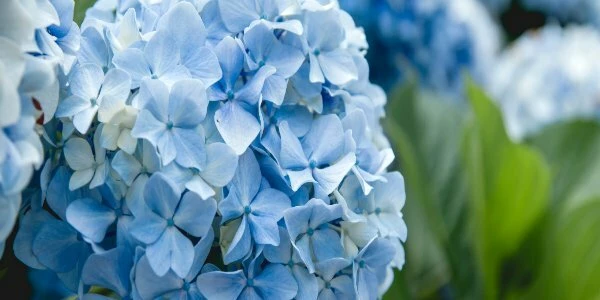
- when iron-containing substances are added to the soil twice a month, the flowers acquire a blue tint. Iron causes an increase in soil acidity, which contributes to the appearance of blueness;
- to feed one medium-sized bush and color the inflorescences in sky-blue and blue shades, it is enough to dissolve about 10 g of potassium aluminum or ammonium potassium alum in a bucket of water (2 l);
- to acidify the soil and obtain blue flowers, “acidic” water is also used: a tablespoon of citric acid per 10 liters of water. The drug Fitoxylin, which is available for sale, is also suitable for this purpose;
- If you prefer pink, you should make efforts to reduce the acidity of the soil to neutral or slightly alkaline values (pH not lower than 6).
Interesting
It is not uncommon to see a picture where the same bush is full of flowers of different colors on different sides. This effect can be achieved by adding preparations that affect the acidity of the soil (acidic peat or pine needles), not around the plant, but only on one side.

Since lush and long flowering requires additional strength, the crop needs regular feeding. The main stages of the season are distinguished, when the bushes need enhanced nutrition. Below we will consider each of them in detail.
Fertilizers for large-leaved hydrangea after planting
Immediately after planting and in the first year in a new place, the seedling can be watered with a solution of potassium permanganate (pale pink color). This measure will help young, immature plants resist damage to shoots at the base by rot, which often leads to the death of the entire bush.
The well-known Fitosporin (and other similar drugs with fungicidal properties) has similar properties.
On a note
If there is fertile soil and fertilizers are applied during planting, the nutrition is often sufficient for a couple of years of growth and development of the ornamental crop.
In the future, it is recommended to apply organic and complex mineral fertilizers for garden hydrangea under the bush, which can fully provide it with all the necessary micro- and macroelements throughout the season. It will be enough to periodically carry out foliar spraying or add fertilizer under a well-watered bush, providing it first with nitrogen, then phosphorus and potassium.
How to feed large-leaved hydrangea in early spring
The plant requires additional feeding in early spring during the initial growth period. At this time, it needs nitrogen fertilizers to ensure stable growth. Potassium sulfate with the addition of an aqueous solution of urea is quite suitable (dissolve a tablespoon of each preparation in a bucket of water).
Continue such feeding until about mid-July, repeating every 12-14 days. Watering under the bush with liquid manure diluted with water (1:10) has a good effect. The bushes grow well, and enter the main stages of their development in a timely manner.

Fertilizing hydrangeas in summer during budding
At the beginning of summer, in June, when flower buds are forming, use complex fertilizers for flowers. You can alternate nitrogen fertilizers with other mineral complexes, mainly with a predominance of potassium in their composition. It is not recommended to supply the soil with nitrogen for a long time, since the crop will grow faster, and the inflorescences will form weakened.
Both liquid and granular fertilizers are used once a month. The following preparations are suitable:
- Fertika;
- Agricola;
- Kemira for flowers;
- as well as organic aqueous solutions: liquid manure, chicken manure, fermented herbal infusion (especially nettle) in a ratio of 1:10 to water.

For lush inflorescences, alternate watering with herbal infusions, kefir, potassium permanganate, spraying with microelements, acidification with citric acid.
How to feed large-leaved hydrangea before flowering and in autumn
Additional feeding in mid-summer stimulates abundant, uniform and long-lasting flowering. Phosphorus-potassium fertilizers are applied to the crop until mid-August.
First of all, you should use fertilizers for garden hydrangea, balanced in composition taking into account the needs of the plant. They are easy to buy in specialized stores. It is quite simple to use such fertilizers: scatter them in small quantities under the bush and dig into the soil.
note
You can use fertilizers for azaleas, rhododendrons and heather crops.
Also, before flowering, summer residents resort to adding regular superphosphate with the addition of potassium.
At the beginning of September, the bushes need nutrition to prepare for the coming winter. They will need nutritional elements that will allow them to successfully withstand winter frosts.
Watering flowers with an aqueous solution of superphosphate and potassium fertilizer (a tablespoon each) will help the root system withstand a strong drop in temperature. One bucket of solution is enough for watering. Of course, do not forget about using covering materials.

When there is a lack of microelements in ornamental crops
Nitrogen deficiency in the garden beauty is expressed by curling foliage, falling buds and weak growth of the plant. To help the bush, feed it with nitrogen-containing fertilizer:
- urea dissolved in water;
- liquid manure;
- other preparations with a nitrogen component.
High acidity values (pH above 6) create extremely unfavorable conditions for hydrangea. This can result in chlorosis of the plant – it will lose its attractiveness.
Garden hydrangea is a strong water drinker. It should be watered often, almost daily, and on hot days – twice. Do not allow the soil around the bush to dry out for a long time.
With the correct application of organic and mineral fertilizers, timely abundant watering, you can achieve a gorgeous appearance of the bushes. They will bloom from summer to late autumn, pleasing the eye and bringing a lot of positive emotions to summer residents.

More on the topic
 How to propagate hydrangea cuttings in summer – rooting cuttings
  How to water hydrangea to change color and bloom profusely
 Any questions left? Ask them in the comments!