

The pear is becoming increasingly popular among amateur gardeners. This is due to the well-known medicinal properties, and to the fairly stable yield and good taste of the fruits of the new Siberian and Ural varieties. In addition, the pear tree is less susceptible to damage by mouse-like rodents than the apple tree. Have you not yet decided on the choice of pear variety? Then read more about zoned pear varieties, which are guaranteed to give a tasty harvest in the climate of Siberia.
Useful properties of pear
After the apple tree, the pear tree is the most famous fruit tree. And how decorative a pear is during the flowering period, especially against the backdrop of birch, spruce and pine trees. But in our gardens it is rare. Today, when markets are replete with overseas fruits, we need to remember that fruits and vegetables grown in their native climatic zone are most beneficial for a person.
Pears are used fresh, dried (including in the form of flour, which is added to baked goods), and soaked.
1. Wild pears are especially valued for medicinal purposes.
-
The fruits of wild pears last for 2-3 months.
-
They can be consumed gradually fresh, in the form of decoctions, stewed (in the oven with sugar) and candied (caramel).
-
Juice and decoction have an antimicrobial effect.
2. In various forms, the fruits are used for intestinal disorders as a fixative. Pears help digest food and stop vomiting.
3. Due to the high content of arbutin in the fruits (according to L.I. Vigorov, up to 80 mg%), a decoction of pear fruits is an excellent antiseptic, has an invigorating, diuretic and analgesic effect.
Reference
Pear fruits contain a lot of pectin (up to 3.5–4%) and fiber, as well as sugar, acids and biological active substances
4. For the treatment of prostatitis, wild pear compote has been used for many centuries; the effect occurs quickly, until complete recovery.
5. In folk medicine, boiled pears are recommended for bronchitis and tuberculosis.
6. For diabetes, it is useful to drink juice from 70 to 200 g 30 minutes before meals.
7. Pear fruits are recommended to be eaten during treatment of the liver and biliary tract, for salt-free diets for cardiovascular diseases and nephritis.
Pears are eaten 0.5–1 hour after eating. After eating pears, you should not eat heavy food or drink water. The more aromatic the pear, the healthier it is
Pear varieties for Siberia
Siberian scientists have developed varieties of pears that are more winter-hardy than those grown in the center of Russia. They are almost as good in quality as the others and are perfect for growing in any region.
In favorable microzones, pears produce high yields – up to 120 kg of fruit or more can be harvested from one tree.
-
The pear tree develops relatively slowly.
-
At a young age, it is less winter-hardy; with age, the pear’s resistance to the harsh conditions of Siberia increases.
-
Fruiting occurs from 6-7 years after planting.
______________________________________________
PREPARING PEARS FOR WINTER: WATERING, FEEDING, Pruning, TREATMENT
______________________________________________
What varieties of pear can be grown in Siberia?
In Siberia, only hybrid varieties derived from the Ussuri pear can be grown in open form.
-
The assortment is represented by varieties of summer and autumn ripening.
-
First of all, universal varieties with fresh edible fruits are in demand.
-
There are very few dessert varieties derived from the Ussuri pear, and all of them have low winter hardiness.
Large-fruited varieties of domestic pear are grown in the stale form.
Altai pear varieties for Siberia
The most favorable areas for growing pears are the lowlands of Altai and the south of the Krasnoyarsk Territory. In favorable microzones, pears produce high yields – up to 100–120 kg or more per tree. But such high yields occur no more than once every 2-3 years.
Varieties of Altai selection are doing well in the Altai Territory and the southern regions of Siberia:
-
Lel,
-
Perun,
-
Kupava et al.
It is almost impossible to promote these varieties to more northern regions (Novosibirsk, Kemerovo and Tomsk regions). Because they are poorly formed into stylates due to fragile branches, and in this form they almost do not bear fruit.

Krasnoyarsk and Chelyabinsk pear varieties for Siberia
In the northern regions of Siberia, it is preferable to grow small-fruited varieties of pears of the Krasnoyarsk selection:
- small,
- Veselinka,
- Krasnoyarsk large
- The first swallow
Reference
The varieties of Krasnoyarsk selection are highly winter-hardy, bear fruit almost annually, and produce fresh edible fruits.
The varieties of Chelyabinsk selection are winter-hardy, slightly freeze slightly in particularly harsh winters, and recover well:
- Uralochka,
- Myth,
- Krasulya,
- Century-old
Far Eastern pear varieties for Siberia
Old Far Eastern varieties (Tema) winter well in Siberia, produce significant yields, but have fruits exclusively for technical purposes. The crowns of these varieties can serve as a good skeleton-forming material for grafting dessert varieties.
European pear varieties for Siberia
There is promising experience of gardeners (for example, S.A. Peganova) in growing European varieties of pears in the crown of serviceberry in a buried form.
-
A cutting of a cultivated pear variety is grafted in the spring, at a height of at least 1.2–1.5 m.
-
The grafted variety begins to bear fruit two to three years after grafting.
-
The branch is capable of producing up to five harvests, 5–8 kg each.
-
In the winter, the grafted branch is laid on the ground for more complete coverage with snow, and in the spring it is tied to a stake.
Vaccinations should be updated periodically.
Description of pear varieties for Siberia
Siberian pear varieties are much richer in biochemical composition than European ones:
- have a higher content of P-active substances,
- rich in chlorogenic acid, arbutin, tannins,
- rich in fiber, potassium, iron, pectin and organic acids.
Svarog, Perun, Lel, Kupava, Veles – these are the fabulous names of the varieties of Siberian pears.
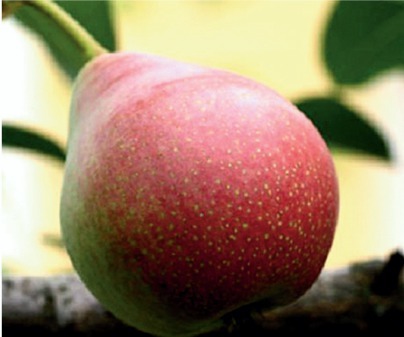
Karataevskaya
The fruits ripen at the end of August and can be stored for 10-12 days.
- Trees of medium height and tall with a sparse crown.
- The fruits are quite large, 105-110 g, round or broadly pear-shaped, whitish with a striped dark red blush.
- The pulp is white, oily, juicy, sweet and sour with a spicy aftertaste, dessert taste.
Fruits moderately – 20-21 kg per tree.
Variety Karataevskaya
Lel
The fruits ripen on August 20-25 and are stored for only 5-7 days after harvest. Those left on the tree do not fall off and do not ripen for a long time.
-
The trees are above average height with a narrow crown and have good winter hardiness.
-
The fruits weigh 65-68 g, broadly pear-shaped, greenish-yellow with a blurred, dull blush.
-
The pulp is tender, juicy, melting, with a dessert taste.
The average yield per tree is 29 kg.
Veles
The fruits ripen at the end of September and can be stored for 12-20 days.
-
The trees are medium-sized, with satisfactory winter hardiness.
-
The fruits weigh 70-75 g, pear-shaped with an uneven bumpy surface, yellow with a red blush.
-
The pulp is dense, juicy, sweet and sour, of good taste.
-
The average yield per tree is 25-27 kg.
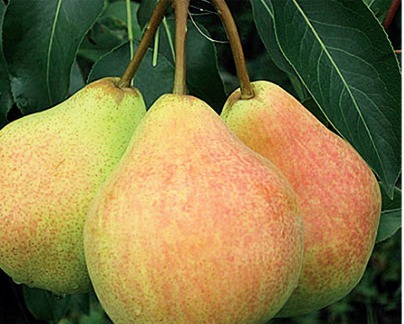
Variety Veles
Perun
The largest-fruited (fruits weighing 135-140 g) of the varieties from Siberia and the Far East. The fruits ripen in early October and are stored for 1.5-2 months.
-
The trees are medium-sized with a spreading crown, with satisfactory winter hardiness.
-
Unripe fruits, collected in late September – early October, have a dark green base color and turn yellow during storage.
-
The pulp is dense, sweetish-sour, of good taste.
The average yield per tree is 24 kg.
Svarog
They ripen at the end of September and can be stored in the basement for 1-1.5 months.
-
The trees are medium-sized with a thick crown, winter-hardy.
-
The fruits weigh 75-80 g, broadly pear-shaped, yellow with a faint dull blush.
-
The taste of the fruit depends on the growing conditions and weather during the growing season: in favorable conditions, the pulp is juicy, tender, sweet and sour.
-
The average yield is 21 kg per tree.
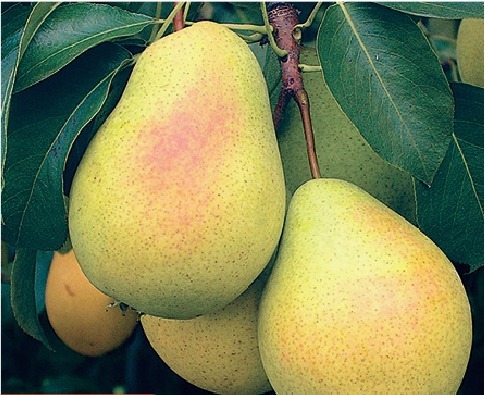
Variety Svarog
Pear varieties for the Novosibirsk region
We provide characteristics of released and promising pear varieties for cultivation in open form in the Novosibirsk region. The description of the varieties is given based on materials from the State Administration of the Region and the own observations of the author, Anna Solovyova, Doctor of Science, nurseryman.
Reference
In the Novosibirsk region, in a free-growing form, it is possible to grow only varieties derived from the Ussuri pear
-
For fairly stable fruiting, varieties must be able to withstand harsh winters (frost, sunburn, snow exposure).
-
The fruits of the pear and the tissue of the tree itself must have time to ripen in a short growing season.
The varieties bred in Altai meet these requirements:
-
Siberian,
-
Zoe
-
Kuyumskaya.
We also do well with the Tema and Polya varieties, however, although their fruits are large, they are not edible when fresh.
Promising varieties
Small-fruited varieties of Krasnoyarsk selection with fresh edible fruits that are winter-hardy are considered promising:
-
small,
-
Veselinka,
-
Krasnoyarsk large,
-
The first swallow.
In recent years, many hobbyists have been quite successfully growing varieties of Ural selection –
-
Hanging,
-
Krasulya,
-
Uralochka
-
Myth.
________________________________________________
EXPERIENCE OF GROWING PEARS IN NOVOSIBIRSK

Description of pear varieties for the Novosibirsk region
Veselinka
the tree is weak-growing, with a pyramidal crown; the flower buds are not winter-hardy enough.
-
The yield is high (from 6-25 to 70 kg/tree).
-
The fruits are medium-sized (30-40 g), pear-shaped, straw-yellow, with a bright blush, very tender, juicy, sweet, with a strong aroma.
-
The fruits are poorly transportable, ripen early (August 25-30), and are stored for up to 10 days.
Zoe
The tree is medium-sized, with a wide pyramidal crown.
-
The yield is high (40-128 kg/tree).
-
The fruits are small (30-40 g), pear-shaped, greenish-yellow with tan, juicy, satisfactory taste, universal purpose.
-
The fruits ripen in early September and are stored for up to 20 days.
Krasnoyarsk large
The tree is medium-sized, with a pyramidal sparse crown.
-
The yield is high (from 6-12 to 75 kg/tree).
-
The fruits are medium and large (40-64 g), pear-shaped, green with light spots, tender, juicy, sweet and sour.
-
The fruits ripen in early September and are stored for up to 3 weeks.
Krasulya
An early-summer ripening variety, the tree is winter-hardy, recovers well, is medium-sized, with a rounded, sparse crown.
-
The yield is average (17.5 kg/tree).
-
The fruits are large (50-80 g), oval-round, juicy, sweet, universal purpose.
-
The fruits ripen in the second half of August and are stored for up to 10 days.
Myth
A late-autumn ripening variety, a medium-winter-hardy tree, vigorous with a narrow pyramidal crown.
-
The yield is moderate (11.2 kg/tree).
-
The fruits are large, one-dimensional (35-50 g), golden yellow, good taste, universal purpose.
-
The fruits ripen in September and are stored for up to two months.
Nevelichka (Thumble)
The tree is small, with a pyramidal crown, winter hardiness is satisfactory.
-
The yield is moderate and high in the southern regions (8-13 and up to 30-125 kg/tree).
-
The fruits are small (27-37 g), short pear-shaped, straw-yellow with a brown-red blush, very juicy, sweet and sour with a strong aroma.
-
The fruits are transportable, ripen in early September, and are stored for up to 25 days.
The first swallow
The tree is small, with a rounded crown, winter-hardy, and early-bearing.
-
The harvest is small (up to 10 kg/tree).
-
The fruits are round, short pear-shaped, small (up to 30 g), yellowish-green, juicy, sweetish-sour.
-
The fruits ripen at the end of August and are stored for up to 25 days.
Hanging
The tree is medium-sized, medium-winter-hardy (successful in certain microzones), with a rounded crown, early fruiting.
-
The harvest is moderate.
-
The fruits are large (40-60 g), oval, greenish with a blush, juicy, sweet and sour.
-
The fruits ripen in September and are stored for up to 1.5 months.
Siberian
The tree is medium-sized, with a rounded crown, early fruiting.
-
The yield is moderate (from 4.5-20 to 50 kg/tree).
-
The fruits are round, light green, medium-sized (30-40 g), tender, juicy, sweetish-sour (for processing).
-
The fruits ripen in late August – early September, are transportable, and can be stored for up to one month.
Uralochka
The tree is medium-sized, winter-hardy, early fruiting.
-
The harvest is moderate.
-
The fruits are large (40-60 g), greenish-yellow, juicy, sweet and sour.
-
The fruits ripen in September and are stored for 1 month.


