

Mesembryanthemum cultivation, mesembryanthemum care, photos, characteristics of the flower, wintering and the period so far – read everything that is useful for a gardener to know further in this article.
The content of the article
- Features of the mesembryanthemum
- How the crystal daisy blooms
- Popular types and varieties
- Landing
- Plant care rules
- Diseases and pests
Features of the mesembryanthemum
Mesembryanthemum is a biennial, annual and perennial family of Azizaceae, translated from Greek as “midday flower” and of all exotic plants it is one of the most spectacular and unusual. There are up to 80 species known to science in its genus.
Its appearance in your garden will not go unnoticed, and you will have to explain more than once what kind of flower it is and promise to share the seedlings.
Midday, sunflower, sunflower – this is how it is called due to the interesting feature of the first species discovered by man. These species close their buds in cloudy and rainy weather, as well as at night, and bloom only in sunny weather. The natural habitat of sunflower is Australia, Chile, South Africa, and some particularly hot European regions. Existing in such a hot climate, where droughts and very high temperatures often occur, the sunflower has acquired a number of characteristic features for survival: its stem is covered with thin hairs that prevent the formation of moisture, which can, like a lens, intensify the direct rays of the sun and burn the plant. Also, the midday plant is a succulent plant – this means that it has special tissues for accumulating and storing water reserves, like a camel.
The greenery is varied in shape and size, closer to the rhizome it is larger and more lush, the closer to the inflorescences, the smaller and sparser it is. The shape varies depending on the variety. On the surface of the leaves there are papillae with juice, which adds a crystalline shine to them in the sun when it has just rained or dew has fallen – hence such names as glass chamomile, crystal grass and ice grass.
How the crystal daisy blooms
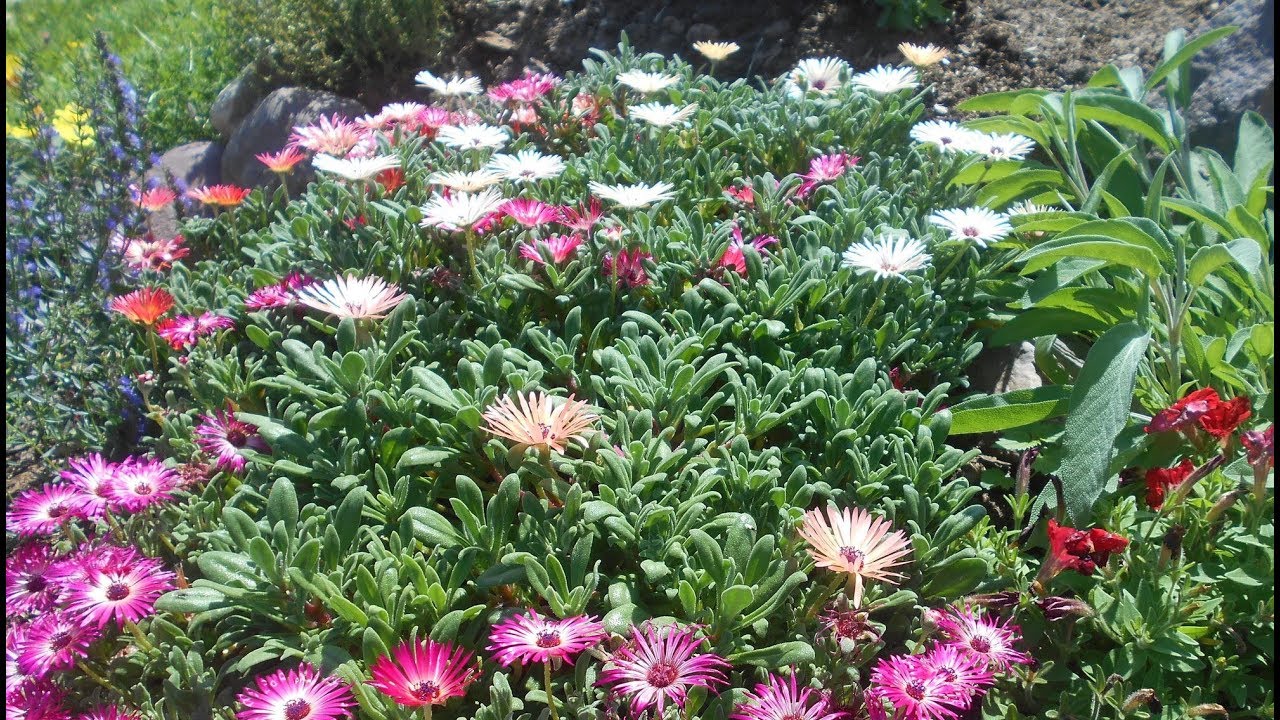
Crystal grass flowers look like carnations or daisies, reach 8 cm in diameter and are found in white, pink, red, crimson and other shades. They behave unusually actively, they rarely walk – some species bloom only in the sun, while others only in cloudy weather or at night.
Popular types and varieties
This unusual flower is not easy to find on sale, although it looks wonderful. Perhaps many are put off by its exoticism and lack of information about growing and caring for it. Of the variety of choices, 5 main types are cultivated: crystal, grass-like, daisy-like, cloudy and ocelliform.
Crystal
Not tall, more of a creeping, wide-spreading perennial native to South Africa, which reaches 15 cm in height. It has many stems covered with small, fleshy, oval-shaped leaves with wavy edges that are pale green in color. They fit tightly to the stem due to their short petiole and grow opposite each other. Depending on the variety, their length varies from 20cm to 2cm.
The flowers are shaped like daisies or daisies and are collected in inflorescences of several pieces. The petals are on average about 5 mm wide and can reach a length of more than 5 cm. The shades are predominantly orange, pink and white.
The most popular varieties are Sparkles, Harlequin and Limpopo.
Grass-like
An annual branchy representative with many shoots, but an erect stem. The stem itself has an unusual reddish color and grows on average about 12 cm. The foliage is fleshy, covered with hairs, 50 mm long, forming a bush from which flower stalks with one bud at the top are already emerging.
The flowers are tricolor: dark pink in the center, white closer to the middle and light pink at the edges. By themselves, no more than 3.5 cm in diameter.

Daisy-shaped
Otherwise, it is a hair-flowering annual plant about 10 cm tall. The leaf blades are long – 75 mm, with papillae on the surface to collect and store moisture. The stem is creeping and thick, making the variety well suited for hanging pots.
It blooms in summer, the buds open up to 4cm in diameter and are colored in red, pink, bright purple, apricot, orange and yellow. They open only in the sun, the rest of the time they seem to sleep.

Cloudy
The most frost-resistant ground cover species in the entire genus, it acquires a bronze tint from the cold. It is considered an evergreen plant. An adult bush reaches 10 cm in height. Due to the fact that although it is a shrub, it is also a creeping plant, and as a result it covers its area with a real carpet of greenery, which can be successfully used in landscape design.
The foliage densely covers the stem, oval shape, bright green color. The flowering period begins in late spring and continues until frost. Petals are golden yellow, orange, red and purple. Flower diameter is about 35mm.

Glazkovy
Dianthus biennial. A distinctive varietal feature is the unusual color of the flowers – the center is burgundy-red, the petals are yellow or white. The length of the sheet plates is from 10 to 45 mm. The height of the bush is about 10cm.

Harlequin
One of the brightest garden varieties of crystal grass with double-colored petals – pink and orange. Good for decorating borders. The flower size is about 6cm in diameter.

Sparkle
And another variety of crystal mesembryanthemum with flowers about 4.5 cm in diameter and amazing leaves of white and yellow color. The varietal feature is the white edging in the middle of the flower. The petals are orange or pink.

Landing
Mesembryanthemum planting. Although he is exotic, no special whims were noticed behind him. Even a novice amateur gardener can easily cope with its planting and cultivation. It will probably be more difficult to find planting material than to use it later.
When to plant mesembryanthemum
The main guideline for determining planting dates is the onset of stable warm weather. Closer to the south it will be the month of April, and further north it will be the beginning or middle of May. The time for planting seedlings is calculated in such a way that at the time of planting them in open ground, the seedlings are already at least 2 months old.
Landing rules
No special processing of planting material is required. With the exception of cuttings, when the cut sites must be treated to avoid infection. But it is advisable to disinfect the soil for seedlings. Otherwise, all that is required is compliance with the sowing dates and site selection conditions.
Planting in open ground
Properly prepared soil is the key to successful development and flowering of the plant. The soil is preferably light, sandy with good drainage properties. The place is preferably sunny, but protected from the north and north-west winds.

Reproduction
Midday is propagated by three classical methods: seeds, seedlings and cuttings. Cuttings are resorted to when it is necessary to preserve a favorite variety with all its characteristics, which may not be possible when propagated by seeds. The seedling method is necessary for regions with cold climates. And propagation by seeds, although the simplest of all methods, is suitable only for warm countries.
Growing from seeds
Sowing seeds in open ground can be done in the south of our country, in those rare areas where a temperate and subtropical climate prevails.
- In the area for sowing, narrow grooves are made for the seeds.
- The seeds are carefully sown in these grooves and only lightly sprinkled with soil.
- The soil needs to be slightly moistened.
- When the shoots appear and get a little stronger, remove the weakest of them, so that a distance of about 20 cm is maintained between the remaining ones.
- If there are a lot of good sprouts and it’s a shame to throw them away, carefully replant them. To do this, use a small garden scoop – the shoot is dug up along with a lump of earth, transplanted to a new place and watered a little.
Growing seedlings
To sow seeds directly into the open ground of this southern guest, the duration of our summer season is not enough, and accordingly there is not enough light and heat for full development. Therefore, in regions with cold climates, gardeners resort to propagation by seedlings.
Prepare the soil mixture. To do this, mix two parts coarse sand, two parts peat and one part garden soil. The resulting mixture must be heated over a fire or the spill must be disinfected with a solution of potassium permanganate.
The soil is kept in a dark, warm place for about 15 days. This time is necessary for the reproduction of beneficial microorganisms in it.
Since the seeds are very small, they are dispersed as evenly as possible throughout the container. After which they just need to be lightly pressed down with a fingertip and all the crops are sprayed with a water sprayer.
The container is covered with film to create a greenhouse effect. And stored in a cool but well-lit place at a temperature of +16 degrees. If there is not enough lighting, place a fluorescent lamp nearby.
In about a week, the first shoots will begin to appear. Now the film needs to be removed, and the pot should be placed in a cooler place and stored there at a temperature of about +12 degrees.
It will take about another month for all the other shoots to sprout.

Cuttings
The most suitable period for cuttings is from the beginning of March until about mid-May. At the cutting sites, the cuttings are treated with a solution of potassium permanganate or wood ash. For their germination, sandy soil is best suited, which must first be calcined over a fire.
The cuttings are planted in prepared soil and not often watered moderately – an excess of water and shade can cause rotting. The storage location is preferably sunny and warm.
Plant care rules
Although glass daisy is an exotic plant, it is surprisingly not capricious. If the location is suitable and the soil is good, then it does not require special care: there is almost no need for watering, and fertilizers are needed only during the flowering period. Weeds are removed as necessary to maintain neatness in the flowerbed. But they will have to help them through the winter as much as possible.
Do plants need to be pruned? There is no need for this.
Rules for watering and fertilizing
For what, for what, and for a lack of water, ice grass is ready like no other. A clear sign that it is time to water is significant drying of the top layer of soil. Therefore, it is necessary to water it very little and only during periods of prolonged drought. The rest of the time, watering is not only not necessary, but also not desirable. If the weather is too rainy, it won’t hurt to cover the plantings with film to prevent the soil from getting wet and becoming oversaturated with moisture.
Until the ice grass begins to bloom, literally one or two small feedings will be enough for it. Fertilizers in large quantities can even be harmful, and there will be no flowering. During the flowering period, fertilizing is applied every 15-25 days. A solution of complex fertilizers for succulents is well suited for this.
Rest period
Since our southern beauty cannot fully grow in the open air, many gardeners grow it as a house plant. And when the street sunflowers go to sleep for the winter, their domestic counterparts begin a period of rest. During this period, they should not be disturbed, watered or flavored in any way – they rest and gain strength before the new season.
It is enough to move the pots to a cool, dark place and store them there at a temperature no higher than +10 degrees.

How to collect mesembryanthemum seeds
Collecting seeds is not particularly difficult. Wait until the flowering period ends, collect seed pods from the bushes and place them in warm water. There they will open and the seeds can be collected. The seeds are dried in a dark, dry, well-ventilated place and stored in a paper envelope.
Wintering
How to preserve in winter? In cold climates, the midday bird will not be able to survive the winter without human help. To do this, you will have to carefully dig it up along with a lump of earth, transplant it into a pot and store it in a dark, dry place at a temperature of about +10 degrees.
In the spring, at the beginning of March, these bushes are cut, transplanted into containers, and then cared for as with ordinary seedlings.
Diseases and pests
Glass chamomile is not only very unpretentious, but also resistant to diseases and pests – the main thing is to maintain an acceptable level of humidity for it.
- Of the pests, only spider mite. Periodically spray the plantings with an insecticide solution, and they will not bother you.
- If the permissible humidity level is exceeded, it may begin rottingand the bushes will stop flowering.
- And if there is a lack of sunlight, the buds will stop opening and the greenery will fade greatly.
To treat patients, it is necessary to normalize humidity and lighting: eliminating the shadow, or adding artificial light.


