

What to do if the apple tree did not want to bear fruit, shed its ovaries and produced a meager harvest? What is the reason and how can you help the tree regain its strength for abundant fruiting? Let’s talk today about how to get truly large apple harvests every year. The secret lies in simple but important rules of care. The apple tree needs to be regularly and annually pruned, the crown shaped, the harvest rationed, regularly watered and fertilized, and protected from diseases and pests.
Why does the apple tree bear fruit poorly and what to do?
Every gardener wants to receive annual and stable harvests of apple trees, but, alas, this does not always work out. Sometimes an apple tree bears fruit poorly, literally a dozen apples ripen on a tree, and sometimes in one year it produces a huge harvest, and then “rests” for a year or even two, not pleasing the gardener even with flowering.
There are quite a few reasons why an apple tree does not bear fruit or produces a poor harvest, ranging from the banal lack of a pollinator to serious viral diseases.
Over the years of growing fruit trees, I have identified 5 main reasons for poor apple harvest:
-
Incorrect pruning and crown shaping
-
Lack of crop standardization
-
Irregular watering
-
Malnutrition
-
Damage by diseases and pests
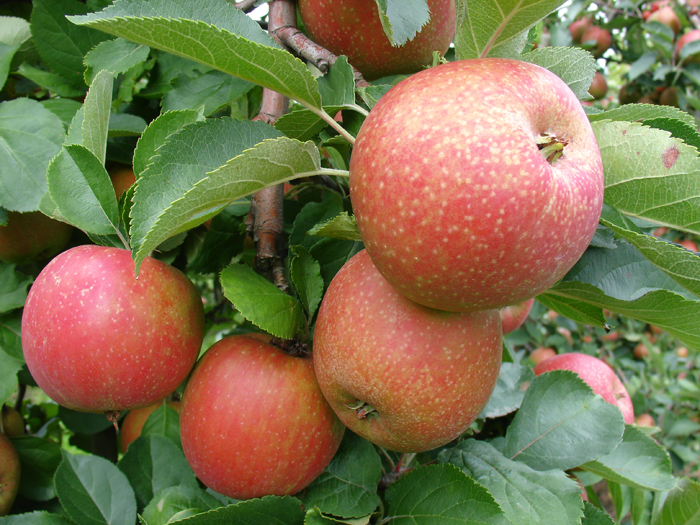
To ensure that the apple tree bears fruit, plant several varieties of apple trees for good pollination.
1. Incorrect pruning of the apple tree
Very often, poor apple tree productivity or even a complete lack of fruiting in some years is associated with poor pruning, improper formation of the apple tree, or the complete absence of these operations.
What pruning should I do on an apple tree?
You should know that apple trees need to be pruned every year. It is not necessary to do complex shaping – not everyone can do this, and it is really difficult – sometimes there are only a few specialist edgers, even for a large city. But sanitary pruning – removal of dry, broken shoots growing in the center of the crown and leading to its thickening, tops (vertical fattening shoots on which there will be no fruit) – must be carried out.
When to prune an apple tree?
It is better to prune early in the spring, always before the buds open. You can prune an apple tree in late autumn, and sometimes it is done in winter if the frost is no more than 10 °C. First, be sure to take a good look at the tree: visually evaluate what is unnecessary, what needs to be corrected, and what should be left untouched. You should know that the general principle of crown formation is to form branches like this:
- so that they don’t interfere with each other,
- so that the shoots grow not into the center of the crown, but outward, thereby not thickening it,
- so that the angle of departure of the branch from the trunk is as large as possible.
Shoots with a maximum angle of departure form a maximum of fruit buds on their surface, and therefore flowers, and therefore fruits.
My tips for pruning an apple tree
-
Start pruning by removing all the shoots that grow inside the crown of the apple tree and those that compete with each other – growing in the same place and in the same direction.
-
Start pruning from the top of the crown; here the shoots can be safely shortened by about 1/3 of their length.
-
Be sure to inspect the place of the cut, cut to the bud, which is directed away from the center of the crown and from which, with a high degree of probability, given its location, the shoot will not grow vertically, but as close as possible to the horizontal position.
-
To reduce the height of the apple tree, simply cut off the central conductor – that very long central shoot, the center of the crown.
If to remove all the tops (vertical shoots) you have to cut off more than half of the crown, it is better to bend them back rather than trim them
- Tie twine to the tops and attach them to lower shoots or to pegs that can be carefully driven near the apple tree.
- Or tie weights to such branches, for example, pieces of bricks. The thicker the branch, the heavier the weight should be and vice versa.
- If the shoots are young, then you can not tie weights to them, but install spacers between them of such length that the shoots become more horizontal.
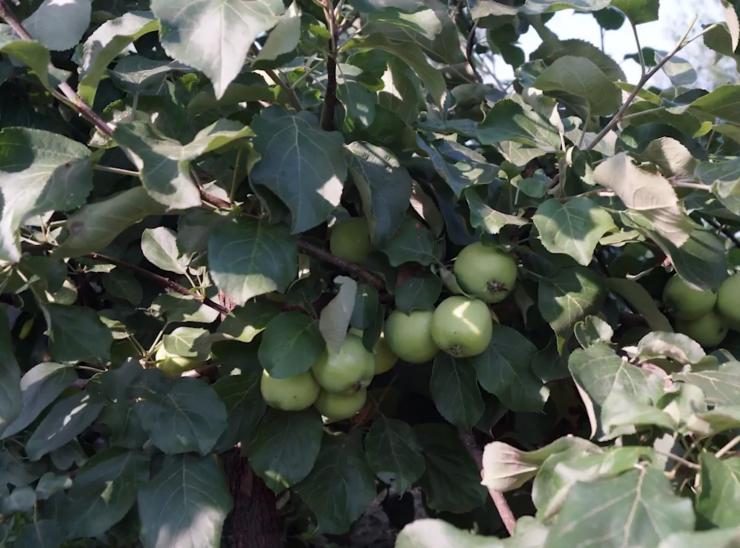
The apple tree does not bear fruit and produces a poor harvest due to improper pruning and shaping or its complete absence
2. Lack of yield rationing
It happens that, out of ignorance or “out of greed,” gardeners ignore such a technique as crop rationing. It is precisely because of the lack of normalization that in some years the apple tree may not bear fruit or produce very modest yields.
Why is normalization needed?
Harvest rationing makes it possible to eliminate the periodicity of apple tree fruiting, when huge harvests alternate with seasons when the number of apples on the tree is minimal or non-existent.
It is advisable to carry out normalization at a young age of trees so that the developing plant does not suffer from overload with the harvest, in order to stimulate not only the ripening of fruits, but also the growth of shoots, the full development and formation of the crown.
What are the risks of harvest overload on young apple trees?
- Inferior development of the crown and trunk.
- Incorrect and insufficient anchoring of plants.
- When grown without support and in a strong gust of wind, apple trees overloaded with harvest may fall.
- Young apple trees, weakened by large harvests, often suffer from diseases, because their immunity is greatly reduced.
Council
Do not forget to loosen the soil in the tree trunk area during the season – this will improve soil aeration, help the absorption of fertilizers and moisture, which means the harvest will be higher.
When to standardize an apple tree?
- You can start normalizing when there is an abundance of pollinators – for example, if you have an apiary nearby – even during the flowering period. Remove about 1/3 of all flowers.
- It is best to play it safe and carry out normalization during the period of ovary formation.
- Even better – after the ovary falls in June – then it will be clear exactly how much harvest the tree has laid.
How to properly standardize an apple tree?
The normalization process itself – removing flowers, ovaries or too large fruits – is not physically difficult, but it really takes a lot of time.
- You can remove the ovaries with your hands, scissors or pruners.
- You can remove about 1/3 of the ovaries.
- First of all, I advise you to remove ovaries with various kinds of flaws or those that are obviously smaller than the rest.
If it is difficult for you to standardize the harvest, then after the June fall of the ovary for a week, once a day you can approach the apple trees and shake them – this will allow some more of the ovary to fall off.
Ideally, the result of crop normalization should be the following picture – 1-2 apples in a “bunch” grown from each flower bud
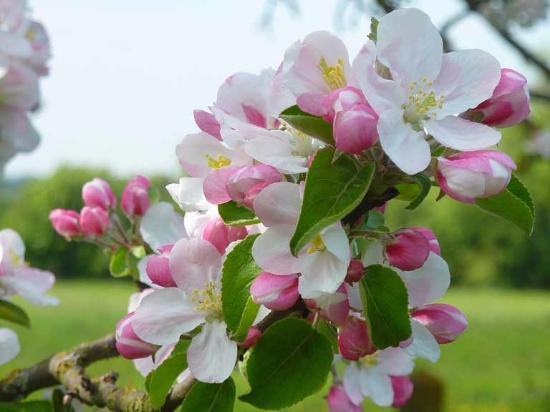
Normalize the apple tree after the ovary falls in June
3. Irregular watering
If there is a lack of moisture, the apple tree will never produce a large harvest. In conditions of insufficient watering, the overwhelming number of ovaries will be shed, quite possibly that’s all. In dry conditions, an apple tree can bloom quite tolerably, but you will not see any fruit, or there will be very few of them.
How to water an apple tree correctly?
If over the weekend we poured 10 buckets under the apple tree, and then the tree stands in the scorching sun for 5-6 days without watering, then there is nothing good in such watering. Of course, this is better than no watering at all, but even such watering can have a bad effect on the harvest.
The rate of watering usually depends on the age of the apple tree:
- 1 bucket per day for an apple tree 1-2 years of planting:
- 2 buckets per day for a 3-5 year old apple tree,
- 3 buckets per day for an apple tree over 6 years old.
Look at the weather outside the window: if it is raining, damp and cool, then watering is not needed, because excess moisture in the soil does not bode well either.
How to drip water an apple tree
Ideally, drip irrigation is suitable for an apple tree. It can be done quite simply:
- a tank is installed on an elevated surface, then a filter, maybe the most primitive one, then a tube with droppers – everything is now on sale and costs literally pennies,
- the tubes are laid out so that there are a pair of droppers in the near-trunk area, water flows out of them drop by drop, feeding the plant;
- The rate of moisture poured out is regulated by the strength of the water flow.
With drip irrigation, the apple tree constantly receives moisture and consumes as much water as needed
Moisture-recharging watering of apple trees
During peak periods of the season, moisture-recharging irrigation should be carried out:
- Once a week, 5 buckets of water are poured under the young apple trees,
- for apple trees over 6 years old – 10 buckets of water.
There are 3 peak periods for apple tree development:
- in the spring, immediately after the buds open, regardless of how much snow there was and if there is no melt water in the tree trunk area,
- 10 days after the end of flowering,
- 20 days before the start of harvest.
Autumn watering of an apple tree
Separately, it is worth mentioning the autumn moisture-recharging irrigation, which is usually carried out at the end of October:
- 10 liters of water are poured under young apple trees,
- for apple trees older than 6 years – 20 buckets of water.
Important
Do not forget to loosen the soil in the tree trunk area during the season – this will improve soil aeration, help the absorption of fertilizers and moisture, which means the harvest will be higher.
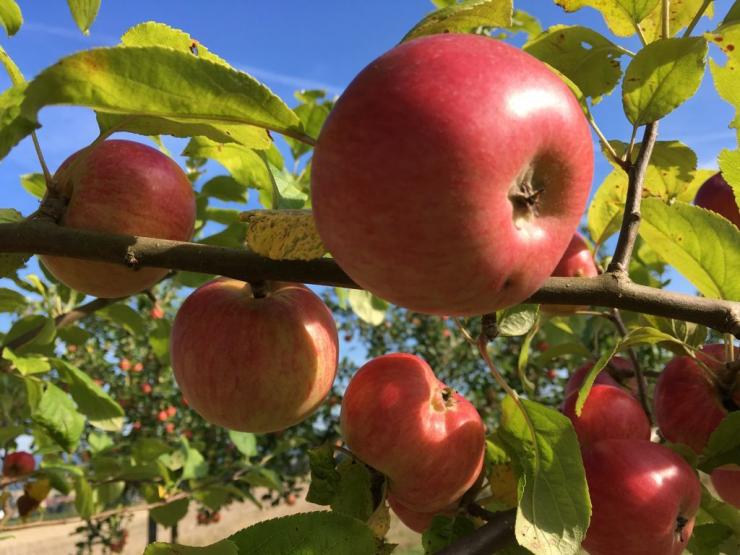
For good fruiting, water the apple tree regularly and generously during peak periods and in the fall.
5. Poor nutrition
An apple tree definitely needs plenty of nutrition. On poor soils, the tree will get rid of ovaries and will not produce a rich harvest. Key fertilizing is carried out in spring and autumn. In the summer, feeding apple trees is not necessary, but is advisable.
How to feed an apple tree in spring
In spring, it is better to focus on nitrogen fertilizers. This could be urea or ammonium nitrate.
Apply nitrogen mineral fertilizer to the pre-loosened and well-watered soil near the tree trunk:
- 2 tsp each under a young plant,
- 2 tbsp each for an apple tree over 6 years old
It can be applied either dissolved in water or dry.
How to feed an apple tree in the fall
Autumn is the time to apply superphosphate – half a couple of teaspoons for a young tree and a tablespoon for a tree older than 6 years and potassium sulfate – it is better to apply it dissolved in water, the application rates are the same. In the fall, immediately after the entire crop has been harvested, it is advisable to spray the trees with superphosphate and potassium sulfate – a tablespoon per bucket of water of both fertilizers, dissolving them in the water as well as possible.
How to feed an apple tree after flowering
After flowering, when the ovaries are actively forming, therefore, we cannot interfere with pollination in any way because it has passed, foliar feeding can be done, for which the trees can be sprayed on the foliage with nitroammophos dissolved in water in the amount of a tablespoon per bucket of water. I strongly recommend this kind of spraying be carried out exclusively in cool weather, but it is clear that not in the rain, optimally in the evening.
Council
Do not forget to loosen the soil in the tree trunk area during the season – this will improve soil aeration, help the absorption of fertilizers and moisture, which means the harvest will be higher.
6. Diseases and pests – prevention
Both diseases and pests cause serious damage to the crop, can cause its complete absence, and often even lead to the death of the tree. Naturally, we need a separate, serious material to talk about how to cure this or that disease or fight this or that pest, but it’s quite possible to talk about how to try to prevent the manifestation of a disease or the appearance of a pest.
So, to prevent the occurrence of diseases – this is not a panacea, of course, but still, in the spring, before the buds open, it is necessary to treat all the apple trees on your site with 2% Bordeaux mixture. It prevents many fungal diseases, including scab. To prevent the appearance of pests, plants can be treated with insecticides and acaricides against ticks approved for the current season. In the fall, be sure to whiten the trunks, this will protect them from sunburn in winter.

More on the topic

How do you care for fruit crops on your site? Share in the comments.


