Every gardener dreams of getting an excellent harvest of tomatoes using as little chemicals as possible. There is an excellent budget option – regular pharmacy iodine. Pharmaceutical iodine solution is a harmless drug; when taken as recommended, it does not cause harm to humans and plants when feeding. Let’s talk about why tomatoes need this component during the period of growth and development and how to properly feed tomatoes with iodine.
Table of contents
1. What is the effect of using iodine for tomatoes?2. What will indicate an element deficiency3. How and when to use fertilizer4. Using iodine for tomatoes in open ground 4.1. Root feeding 4.2. Foliar spraying5. How to use the product in a greenhouse6. General recommendations
Why do tomatoes need iodine?
It turns out that there is quite a lot of this element in the composition of chernozem, chestnut and floodplain soils, which podzolic, gray soils, solonchaks, brown and other types of soils cannot boast of. How is iodine useful, that it has become a very popular fertilizer for tomatoes among gardeners, and for what purposes is this drug used?
The microelement is necessary for the plant and serves not only as a nutritional supplement, but also as an excellent prophylactic against various diseases. This is a strong natural antiseptic.
Reference
It has been established that tomatoes are very sensitive to the addition of this microelement. After feeding, you will immediately notice the benefits of the drug. This is expressed in the abundant growth of above-ground organs, activation of fruiting at an earlier date and increased resistance to diseases, primarily to root rot and late blight.
Tomatoes need a little of this substance, which is why it belongs to microelements. Unfortunately, you will not find special preparations on sale that contain this element in the required quantity due to its microscopic necessity. Therefore, you have to prepare the fertilizer yourself.
On a note
The iodine content in manure, ash and phosphate rock is quite high.
First of all, iodine solutions are used for fungal diseases and late blight, which affects all nightshades everywhere. As soon as you notice the first signs of the disease, immediately begin a merciless fight. The main thing is not to be late, because external manifestations will become noticeable after the plant disease.

The benefits of iodine supplements for tomatoes
Tomatoes respond well to iodine-containing fertilizers:
- Nitrogen metabolism improves. Often used as an alternative to nitrogen fertilizers. Used in small doses, this eliminates the process of accumulation of nitrates in vegetables.
- Stimulates early fruiting.
- Increases plant immunity, improves their growth and development.
- The application of the drug will have a beneficial effect on the human body when the resulting fruit harvest is used in nutrition.
- Due to the content of potassium iodide, the soil is also enriched with this macronutrient.

How to recognize iodine deficiency in tomatoes
Plants can signal a microelement deficiency as follows:
- Strong, powerful plants have grown, but fruiting is slow and weak. Although your neighbors have been seeing fresh fruits on their bushes turning red for a long time.
- You have established that plants are severely affected by root rot, brown spot, late blight and viral diseases. This is especially dangerous for young, immature seedlings. If the treatments don’t help, your plants are probably not getting enough iodine.
- Tomato bushes are lagging behind in development, the foliage is pale, limp, thin stems. Especially noticeable on seedlings.
To be fair, we admit: these “symptoms” are also observed for other reasons. It is very difficult to say categorically that your pets are suffering precisely because of a lack of iodine. Therefore, carefully inspect the bushes regularly.

How and when to add iodine to tomatoes
Like any other fertilizer, iodine can be applied in two ways: on the leaves (non-root) and under the root (root). Both methods are equivalent, it is recommended to use them one by one, alternating. In this case, the plants not only receive the necessary nutrition, but are also protected from various pathogens.
The drug is useful at all stages of plant development:
- For pre-sowing soaking of seeds.
- Seedling processing.
- Application on plants planted in a permanent place.
We have already repeatedly told you how to properly prepare tomato seeds before sowing. Let me briefly remind you: you can soak the seeds before sowing in a solution: 1 drop of iodine x 1 liter of water for 6 hours.
How to water tomatoes with iodine in open ground
Let’s look at the use of the drug at subsequent stages of plant development. The algorithm of actions here is almost the same for plants of any growing method: open ground and greenhouse structures.
Root treatment of tomatoes with iodine
Let’s consider the methods and frequency of fertilizing tomatoes in open ground.
- First feeding. The most optimal time is the formation of the second pair of true leaves of the seedlings. Pour a little solution under each root: add one drop of iodine to 3 liters of warm water. Don’t worry, this is quite enough at first.
Important!
It is very important in the matter of feeding to comply with the measures. With such a weakly concentrated solution, you can water slightly dried soil in a pot once, replacing the next watering.
- Second feeding. The initial stage of tying the first brush. Water with warm water (about +20 degrees) with iodine dissolved in it in the proportion: 10 liters of water and 3 drops of the drug. Consumption depends on the size of the bush and is 0.7–1 liters for each root.
Recommendation
Do not use chlorinated cold tap water.
- Third feeding. Carried out if necessary.
You must determine this yourself by carefully examining your pets. If there is still not enough iodine, feed it during the fruiting phase with a solution richer in nutrients.

Boric acid and iodine for feeding tomatoes
Boric acid gets along well with iodine. Recipe for feeding tomatoes with nutrients:
- Dissolve 3 liters of ash powder (it’s good that now you can often find it in gardening stores and don’t worry about where to get it) in 5 liters of hot water.
- Cover and cool for about an hour.
- Now you can pour in a regular pharmaceutical bottle of iodine and a bag (10 g) of boric acid.
- All that remains is to increase the total volume of the solution to 10 liters by adding warm water. Leave the resulting composition for a day, during which do not forget to stir it regularly. This solution is used as a stock solution and with additional dilution in warm water 1:10 l. Water at the root.
| Recipe for feeding tomatoes with iodine and boric acid |
| Thoroughly mix 8 liters of boiling water and 2 liters of ash sifted through a sieve.
After cooling, pour in a regular bottle of iodine and 10 g of boric acid. To use, take 1 liter of the solution, which has been steeped for half a day, and dilute it in a bucket of water. Due to the rich composition of micro- and macroelements, this solution can be used as the main root feeding of tomato bushes. The recipe is good for preventing late blight. |
The combined application of iodine and boron is especially welcome for the treatment of tomatoes during the fruiting period. This is an excellent stimulant. Often, even a single application is sufficient for the normal development of plants during further growing season. Everything will depend on the overall nutritional composition of the soil and plant development.
Note!
Do not under any circumstances overdo it with the proportions of iodine! This will only harm your harvest. Root overfeeding will immediately affect the quality of the fruits, causing them to deform and worsen the taste.

Foliar spraying of milk with iodine for tomatoes
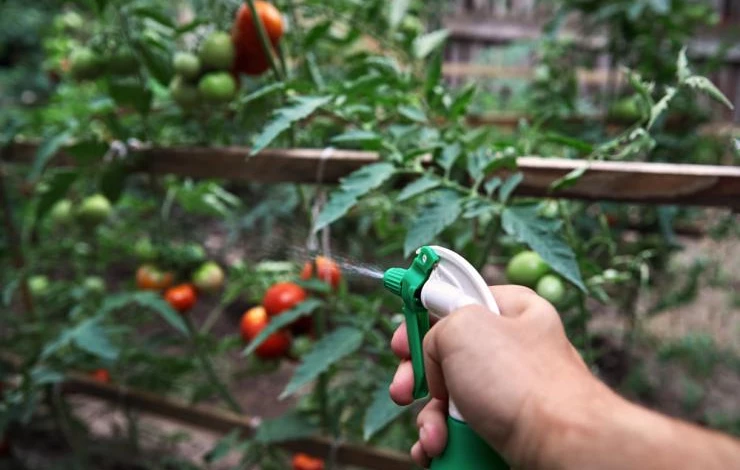
Foliar spraying is carried out early in the morning or after sunset. For the solution, you can use the following recipes, giving the plants not only iodine, but also other trace elements. Recipes based on dairy products:
- Mix 1 liter of warm water, 1 glass of low-fat milk and 5 drops of iodine. Choose the finest mesh nozzle for the sprayer, creating a damp mist when treating plants. Try to lightly wet the leaf surface, otherwise this may lead to burns. Often there is a need for additional treatment with a solution when late blight or other fungal diseases develop. A thin milky film forms on the leaves, preventing the colonization of fungal pathogens.
- Water (9 l) and milk (1 l) are diluted, 10 drops of iodine are added. Effective against powdery mildew. Can be used as a prophylactic every 2-3 weeks.
- Dissolve 20 g of laundry soap, 1 liter of sour milk in a bucket of water, then add 10 drops of iodine.
| Recipe for feeding pododors with the addition of hydrogen peroxide |
| To prevent and treat late blight, treat tomato leaves with a solution: dilute 10 liters of water with 1 liter of whey, add 40 drops of iodine and a spoon (10 ml) of hydrogen peroxide. Used for treating seedlings and adult bushes. |

Feeding tomatoes with iodine in a greenhouse
The timing, processing methods and recipes for solutions are similar to those used in open ground.
But there are some peculiarities. Tomatoes are very popular with various disease-causing pathogens, the pathogens of which prefer to quickly appear and spread in a humid environment. In greenhouses, the most favorable conditions for this develop if they are not used correctly and agricultural practices for growing tomatoes are not followed: frequent watering, lack of ventilation, elevated temperatures and humidity, and dense plantings. Hence the greater volume of infection and crop losses.
In such conditions, fertilizing with iodine solutions will come in handy more than ever. This:
- A natural antiseptic that will help protect plantings from pathogens of fungal diseases.
- Helps greenhouse “residents” survive the lack of light during thickening.
Remember
Spraying tomatoes with iodine should be done in the morning so that the greenhouse is ventilated by night. Iodine is volatile and can be harmful to human health if inhaled for a long time.
In addition to their nutritional and fungicidal functions, iodine solutions successfully repel greenhouse pests.
- Combined use of iodine with brilliant green. Mix 5 liters of water, 5 drops of iodine, 20 drops of brilliant green. Spray every 2 weeks 14–15 days after planting the seedlings in the greenhouse. Treatments are especially relevant during the period of possible rapid development of late blight.
- A popular effective method for enriching greenhouse plants with iodine. Place (hang) a couple of pharmaceutical bottles with iodine in the greenhouse, first opening the caps. For every two square meters, 1 bottle is enough. When using this method, you cannot stay in the greenhouse for a long time: you can be poisoned by iodine fumes.

Photo pixabay/nonstopsmile: You need to work in the morning so that the greenhouse is ventilated in time.
General recommendations for feeding tomatoes with iodine
These tips are suitable for using iodine in a greenhouse and open ground:
- Water young seedlings no earlier than a week after planting in a permanent place.
- Iodine solution is watered or sprayed in doses, no more than twice a month with breaks of at least 10 days. Solutions using dairy products can be used more often.
- Do not water during cool periods. The best time will be morning or evening with temperatures of +18 degrees and above.
- Dilute the drug in warm water.
- Be sure to follow the recommended dosage to prevent leaf burns.

___________________________________________________________________________________
Read other interesting and useful articles about tomatoes:
How to properly feed tomatoes with yeast in open ground and greenhouses: recipes for a good harvest
Caring for tomatoes in June: 5 tips for a good harvest
Why do ovaries fall off on tomatoes and how to fix it
What to put in the hole when planting tomatoes: recipes for open ground and greenhouses
___________________________________________________________________________________
How do you process tomatoes in the summer? Share your recommendations with other gardeners in the comments.